

Two Galileo-satellites into space
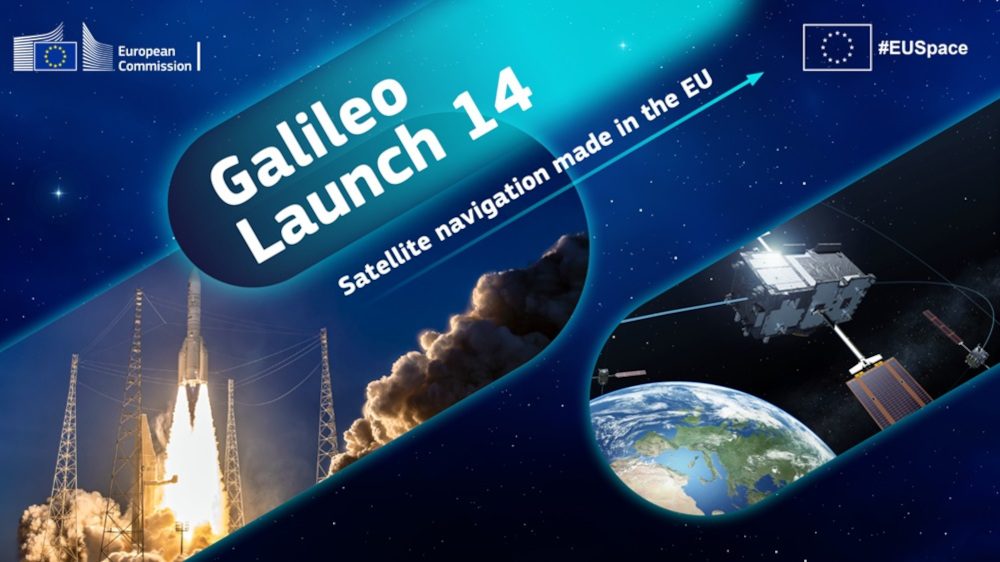
On Wednesday 17 December 2025, two Galileo satellites were launched on Ariane 6 from Europe’s Spaceport in French Guiana in the 14th operational launch of the Galileo programme. These satellites will improve the precision, availability and robustness of the Galileo system by adding spares to guarantee the system can always provide a navigation signal for users worldwide. This was Galileo’s first launch on Ariane 6 and the fifth launch of Europe’s heavy-lift launcher.
The two Galileo satellites, called SAT 33 and SAT 34, arrived in French Guiana on 6 November 2025. Their journey began by plane and by truck and eventually continued by rocket to join Europe’s independent satellite navigation constellation at 23 222 km above the Earth’s surface.
The European Space Agency (ESA) is responsible for carrying out the Galileo launch with Arianespace on behalf of the European Commission. The Galileo satellites were manufactured by OHB, under contract with ESA. Once in orbit, the EU Agency for the Space Programme (EUSPA) will bring the satellites into service and oversee their operation.
About Galileo
Galileo is currently the world’s most precise satellite navigation system, serving over five billion smartphone users around the globe since entering Open Service in 2016. All smartphones sold in the European Single Market are now guaranteed Galileo-enabled. In addition, Galileo is making a difference across the fields of rail, maritime, agriculture, financial timing services and rescue operations.
A flagship programme of the EU, Galileo is managed and funded by the European Commission. Since its inception, ESA leads the design, development and qualification of the space and ground systems, as well as procuring launches. ESA is also entrusted with research and development activities for the future of Galileo within the EU programme Horizon Europe. The EU Agency for the Space Programme (EUSPA) acts as the service provider, overseeing the market and application needs and closing the loop with users.
About Ariane 6
Ariane 6 is Europe’s heavy launcher and a key element of ESA’s efforts to ensure autonomous access to space for Europe’s citizens. Its modular and versatile design allows it to launch all types of missions, from low-Earth orbit to deep space. Standing over 60 metres tall, Ariane 6 can weigh almost 900 tonnes when launched with a full payload.
Ariane 6 has three stages each working in order to escape Earth’s gravity and take satellites to orbit: two or four boosters, and a core and upper stage. For this launch, the rocket will be in its two-booster configuration.
The core stage and the boosters are responsible for the first phase of flight. The core stage is powered by the Vulcain 2.1 engine (fuelled by liquid oxygen and hydrogen), with the main thrust at liftoff provided by the P120C boosters.
The upper stage is powered by the reignitable Vinci engine fuelled by cryogenic liquid oxygen and hydrogen. The upper stage will fire two times to reach the required orbit for this mission.
After separation of the Galileo satellites, the Ariane 6 upper stage will move to a stable graveyard orbit far away from operational satellites.

The first flight of Galileo on Europe’s new heavy-lift rocket Ariane 6 in December is covered intensively on social media channels, publications on the ESA website, videos and photos.
ESA: Galileo launch 14 timeline on Ariane 6
ESA: Galileo L14 liftoff on Ariane 6
European Commission Youtube: Satellite Navigation Made in the EU: Galileo L14
EUSPA: Successful Launch of Galileo L14 Strengthens European Union’s Satellite Navigation Capabilities
EUSPA/Dedicated page for information
As an expert, Tuija Ypyä, who works as a Ministerial Adviser at the Ministry of Economic Affairs and Employment, comments on the event as follows:
It is very good news that ESA was able to launch two Galileo satellites with the new Ariane 6. Galileo is the EU's own satellite navigation system, which gives Finland and Europe strategic autonomy – reducing dependence on GPS, GLONASS and other external systems. This autonomy is critical for security, security of supply and digital infrastructure. Galileo supports domestic industries, such as logistics, intelligent transport, aviation and maritime transport, and enables the development of new IoT and data services. The secure PRS service improves the operational reliability of the authorities in critical situations. In addition, Galileo will create business opportunities for Finnish companies in the space and technology sector, promote research and innovation, and strengthen Finland's role in the European Space Programme.


